Advanced Techniques in Pipeline Welding Examination: Advancements and Technologies for Enhanced Accuracy and Dependability in Weld Analysis
The landscape of pipeline welding evaluation is undergoing a significant transformation, driven by innovative strategies that guarantee to improve both accuracy and reliability in weld analyses. Technologies such as computerized assessment systems and advanced imaging technologies are redefining typical techniques, while non-destructive testing methods make certain product stability is maintained.
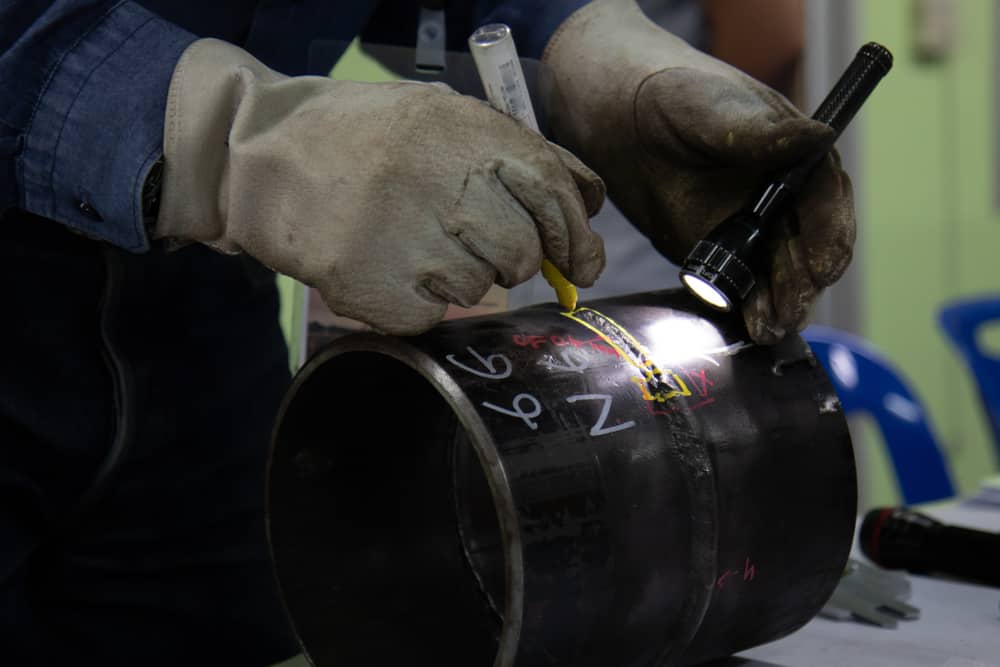
Value of Weld Inspection
Making sure the stability of pipeline welds is vital to the general security and reliability of industrial systems. Rigorous examination of welds is indispensable to the lifecycle of pipe facilities.
The relevance of weld assessment prolongs beyond plain conformity with regulative standards. It works as an aggressive action to recognize and remedy imperfections, such as incomplete blend, porosity, or cracks, prior to they rise into major concerns. Reliable assessment techniques additionally add to the longevity of pipes, minimizing maintenance prices and improving functional effectiveness.
Furthermore, thorough weld evaluations foster count on among stakeholders, consisting of regulative bodies, capitalists, and the neighborhoods offered by these pipelines. By ensuring that all welds satisfy the required requirements, organizations can alleviate risks and maintain their track records. In recap, weld evaluation is vital not only for functional integrity however also for the more comprehensive implications it holds for safety and security and environmental stewardship.
Automated Assessment Systems
The combination of computerized evaluation systems in pipe welding has actually transformed the technique to ensuring weld high quality and stability. These systems employ sophisticated robotics and expert system to carry out examinations that are not only quicker yet additionally much more constant than typical techniques. Automated systems can cover substantial sizes of pipelines effectively, capturing data that human examiners could overlook as a result of tiredness or ecological problems.
One of the essential benefits of computerized inspection systems is their ability to operate in harmful settings, lowering the threat to human inspectors. They utilize various non-destructive testing (NDT) techniques, such as ultrasonic testing and magnetic particle evaluation, to evaluate weld stability without jeopardizing the structure. The data collected is processed in real-time, permitting immediate feedback and prompt corrective actions when defects are identified.
Furthermore, automated systems facilitate the standardization of examination procedures, ensuring that each weld is evaluated against regular standards. This not just improves the dependability of results yet additionally simplifies conformity with regulative requirements. As industries remain to prioritize safety and operational effectiveness, the duty of automated evaluation systems in pipeline welding will certainly expand, leading the way for much more sophisticated quality assurance methods.
Advanced Imaging Technologies
Often employed in modern-day pipeline welding inspections, progressed imaging technologies have actually substantially enhanced the capacity to identify and evaluate weld defects. Methods such as digital radiography, calculated tomography, and thermographic imaging offer assessors with high-resolution images that disclose sub-surface flaws and architectural disparities that might be unnoticeable to the nude eye.
Digital radiography uses digital sensors to catch images, enabling prompt review and boosted image comparison. This leads to quicker inspections and enhanced precision in identifying vital issues. Computed tomography, on the various other hand, supplies three-dimensional imaging, allowing examiners to visualize complicated geometries and analyze the integrity of welds from several angles - Pipeline Welding Inspection. This deepness of evaluation is very useful for finding concerns that traditional techniques might forget.
Thermographic imaging employs infrared innovation to discover variants in temperature level, determining locations of possible weak point or anxiety within the weld. These innovative imaging modern technologies not just boost issue discovery prices yet additionally lower the moment and sources required for pipeline evaluations. Therefore, they play a vital function in preserving pipeline safety and reliability, ensuring compliance with sector criteria while lessening operational dangers.
Non-Destructive Evaluating Methods
Utilizing numerous methods, non-destructive testing (NDT) methods are essential in pipe welding assessments, enabling the evaluation of weld honesty without jeopardizing the product's architectural honesty. NDT encompasses a variety of techniques, including ultrasonic testing (UT), radiographic screening (RT), magnetic bit testing (MT), and color penetrant testing (PT) Each approach has unique benefits and applications relying on the certain requirements of the examination.
Ultrasonic screening utilizes high-frequency audio waves to discover inner problems, providing specific measurements of weld density and click to read more stability. Pipeline Welding Inspection. Radiographic screening utilizes X-rays or gamma rays to generate photos of the weld, disclosing internal issues that may not be noticeable externally. Magnetic bit testing works for spotting surface area and near-surface gaps in ferromagnetic products, while dye penetrant testing highlights surface area cracks by making use of a colored dye
Including these NDT methods right into pipeline welding evaluations boosts the accuracy and dependability of weld analyses, guaranteeing that possible failures are determined early. As sectors demand greater criteria for security and efficiency, the function of NDT in preserving the honesty of bonded frameworks continues to be critical in pipe construction and maintenance.

Future Fads in Weld Evaluation
As we want to the future of weld evaluation, innovations in modern technology are poised to revolutionize the approaches utilized for evaluating pipe stability. The combination of expert system (AI) and device learning in examination procedures is expected to enhance the precision of flaw detection and anticipating maintenance. These innovations permit real-time information evaluation, allowing assessors find more information to determine possible issues prior to they escalate into substantial issues.
In addition, using drones outfitted with sophisticated imaging systems is obtaining traction. These aerial inspections can cover huge locations quickly, catching high-resolution photos and data that can be examined for issues in hard-to-reach locations. This not only boosts safety but likewise raises efficiency in the evaluation procedure.
In addition, the growth of smart sensors installed her comment is here in pipeline systems supplies the potential for continuous monitoring. These sensing units can spot changes in pressure, temperature level, and resonances, providing important insights into the health of the welds over time.

Conclusion
In conclusion, the assimilation of innovative strategies in pipe welding assessment substantially improves the accuracy and integrity of weld evaluations. Developments such as automated inspection systems, progressed imaging innovations, and non-destructive testing approaches play a critical duty in enhancing problem detection prices and promoting proactive upkeep strategies. As these modern technologies remain to develop, they will better make sure the safety and performance of pipeline systems, inevitably adding to the integrity of essential facilities.
